analytics
Sunday, December 27, 2015
Tr(n)^2+Tr(n+1)^2=Tr((Tri(n) + Tri(n+1)) for triangular numbers
I found this about the triangular numbers, also known as the number of distinct pairwise combinations of n items or the sum of the first n of 1,2,3,4,... this wasn't listed on the Encyclopedia of Integer sequences... , The formula for a triangular number is:
I found that:
Provable easily by substituting the formula for Tri in each side:
Tuesday, December 22, 2015
MacLaurin Generating Function
Exponential generating functions follow the form:
I was considering a modification of this structure to read:
Where f_n_(x) at x is both the sequence of coefficients to find the generating function for and the nth derivative at x following the convention of the MacLaurin Series for a function...
If we call this a MacLaurin Generating Function, then we can get some interesting series at x=1...
It continues after 0,1,2,3 with 8,10,54... and I've just learned that these are the Lehmer-Comtet numbers: Lehmer-Comtet
Now we can see what other of these types of series might have simple MacLaurin generating functions, below is if you use x^(2*x)
Maybe not as complicated as it looks when you substitute in x=1 that last 7th derivative is:
Still pretty complicated but the non power of 2 numbers look to be related to multiples of factorials?
The series 1, 2, 6, 18, 64, 220, 888 is not in the Encyclopedia of Integer sequences, but looks interesting! In fact Alois P. Heinz has already pointed out that the exponential generating function for x^2*x is x^2*x itself!
I was considering a modification of this structure to read:
If we call this a MacLaurin Generating Function, then we can get some interesting series at x=1...
It continues after 0,1,2,3 with 8,10,54... and I've just learned that these are the Lehmer-Comtet numbers: Lehmer-Comtet
Now we can see what other of these types of series might have simple MacLaurin generating functions, below is if you use x^(2*x)
Maybe not as complicated as it looks when you substitute in x=1 that last 7th derivative is:
Still pretty complicated but the non power of 2 numbers look to be related to multiples of factorials?
The series 1, 2, 6, 18, 64, 220, 888 is not in the Encyclopedia of Integer sequences, but looks interesting! In fact Alois P. Heinz has already pointed out that the exponential generating function for x^2*x is x^2*x itself!
Factorial sum Maple doesn't know
Considering the sum:
But it's clear this sum should be equal to one, consider the first 7 terms:
If we were to increase the last coefficient by 1 it is exactly unity:
This is because 8/8! is 7! which adds one more 7! to 6/7! to make 7/7! which is 6!, etc.. until you have 1/2! plus 1/2! equaling 1...
It's kind of interesting to think what function would have this as it's MacLaurin series, that at f=1 it is 0, and the first derivative there is 1, and every successive derivative is 1 more than the one before it...
It actually is (x^x)-1, see:
Alternate numbering system
Just considering this series, here are the first 9 terms:
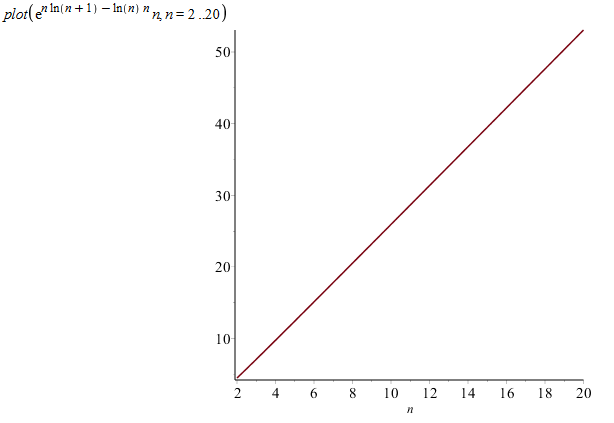
Where the next coefficient is chosen so the sum is as large as it can be not exceeding 1... The growth of the coefficients can be solved for by noting the next term should by multiplied by some a so that it is as large as the previous term when it has a coefficient of 1...
Plotted it is linear:
So I've noticed that this series is basically as efficient for writing any number between 0 and 1 with regards to number of decimal digits as decimal itself is! By the pigeon hole principle no series can be better for getting k decimal digits than the decimal series a1/10 + a2/100...
Thursday, December 17, 2015
Saturday, December 12, 2015
E_Bezier
Normally the quadratic Bezier through three points A,B,C is:
I found an alternative that has some nice properties I'm calling the E_Bezier also through points A,B,C:
Both the Bezier and the E_Bezier are defined over the interval t=0..1, and equal A at t=0 and C at t=1, but the E_Bezier has the property that at t=1/2, it equals exactly B, which is not the case for the Bezier curve...
The acceleration of the E_Bezier curve is exactly double the acceleration of the Bezier curve...
I called it the E_Bezier because it spends "E" qual time between points A and B and points B and C...
**I might continue with an update for higher order than quadratic E_Bezier**
Wednesday, December 9, 2015
Balance scale series
Trying to get the least amount of elements in a series of natural numbers that can be combined by adding or subtracting unique elements of the series to get as many consecutive natural numbers as possible starting with 1. I came up with:
1,2,7, 21, 52
For example
13=21-7-1,
14=21-7,
15=21-7+1, etc... Every natural number less than 84 can be reached by adding or subtracting these first 5 numbers...
The pattern I found is that x-sum(previous) = sum(previous)+1, solve for x, because the previous were able to reach every number up to sum(previous), and you need an x so that subtracting all of those numbers yields every number up to x...
This isn't in the Encyclopedia of Integer sequences yet, but I don't know if it's the best solution...
The name comes from the fact that on a balancing scale, you could weigh any natural number weight by putting the additions on one side of the balance and the subtractions and the object being weighed on the other...
Subscribe to:
Posts (Atom)